
Market entry · English
How to expand a Swedish company to the US: a guide for Swedish CEOs
By Greatweek · Published
Over my career I have taken more than 15 European companies to the US, including SEQR, Paymodum and Floid, and I have worked on the US market from inside PayPal, Visa, Citi and Euronet. Many of the companies I work with today through Greatweek are Swedish, and the conversations with their CEOs follow a familiar pattern.
The product is strong. The team is capable. The company has done well in Sweden and often in the rest of the Nordics. And the US plan is, in practice, the Swedish go-to-market with a US address on it.
This guide is for Swedish CEOs of companies roughly between $1M and $50M ARR who are seriously considering the US. It is not about incorporation or visas. It is about the commercial changes that decide whether the US becomes a second home market or an expensive side project.
Why Swedish companies are well placed for the US
It is worth starting with the advantages, because they are real. Swedish companies tend to arrive with good products, fluent English, a reputation for reliability and a culture of building things properly. US buyers generally respond well to that.
Swedish companies are also used to selling outside a small home market early. Many already sell in Norway, Denmark, Finland or Germany. That experience helps, but it can also mislead. Selling to a Norwegian or Danish buyer is a short step from selling to a Swedish one. Selling to a US buyer is a different discipline.
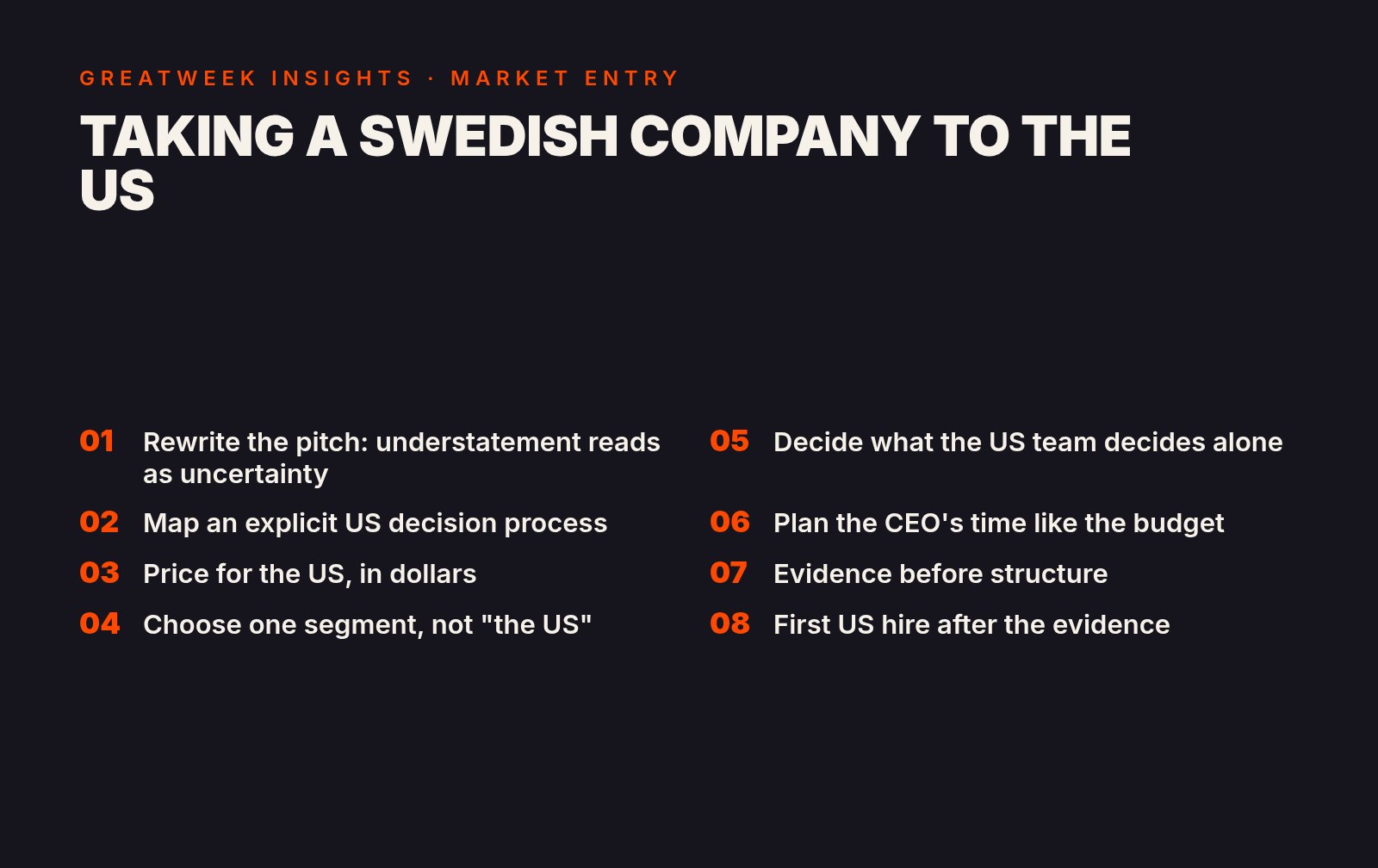
1. Rewrite the pitch: understatement reads as uncertainty
In Sweden, modesty builds trust. A Swedish sales deck often explains the technology carefully, avoids big claims and lets the buyer draw their own conclusions. In a US sales meeting, the same approach is often read as a lack of confidence, or as a sign that the supplier does not really know what the product delivers.
US buyers expect you to say clearly what problem you solve, for whom, what the result is, and how you know. That does not mean exaggerating. It means stating your strongest honest claim in the first minute instead of the last slide.
A useful test: can someone on your team explain, in two sentences, what a US customer gets and why they should care this quarter? If not, the pitch is not ready. Our piece on adapting a European go-to-market for the US covers the full translation, beyond the pitch.
2. Expect a different decision process, not just a faster one
Swedish companies are used to consensus. Many people are consulted, decisions take time, and once made they stick. The common assumption is that US buyers simply decide faster. Sometimes they do. But the bigger difference is that the process is more explicit.
In many US companies, there is a named budget owner, a defined approval path, procurement and legal reviews, security questionnaires and, often, a champion inside the buyer who has to sell your solution internally. If you do not map that process early, a good first meeting can sit in limbo for months.
In every serious US conversation, ask who owns the budget, who else must approve, what the buyer needs to see to move forward, and when they need the problem solved. Write the answers down. "Interested" and "agreed next step with a named owner" are not the same stage of a pipeline.
3. Price for the US, in dollars, from the start
Many Swedish companies convert their Swedish krona price list to dollars and call it US pricing. That is rarely the right answer. US buyers compare you to US alternatives, not to your Swedish price. The value of the problem you solve, the size of the customer and the competition in that segment all differ.
Pricing too low is a common mistake, especially for companies used to price-sensitive Nordic procurement. A low price can signal a small or risky supplier, and it leaves no margin for partners, implementation or the support hours a US customer will expect.
Treat your first US price as a hypothesis and test it with real buyers. Ask what they pay today to solve the problem, what a pilot needs to prove, and who signs. The guide on pricing your first US pilot is a practical place to start.
4. Choose one segment, not "the US"
The US is not one market the way Sweden is. It is many regional and industry markets that share a language and a currency. A Swedish company that launches "in the US" with a small team usually ends up with scattered meetings in five industries and no repeatable story.
Pick one segment, one buyer role and, where it matters, one region or partner channel. Narrowing feels risky for a CEO who sees a huge market. In practice it is the fastest way to learn what works and to build references that the next customer will recognize. If you are still deciding, read how to choose your first US market.
5. Decide what the US team can decide alone
Stockholm is six hours ahead of New York and nine hours ahead of California. That sounds manageable until every US question about price, contract terms or product needs an answer from headquarters. A question asked on a US afternoon gets an answer the next Swedish morning, a follow-up question waits another day, and a buyer's momentum is gone.
Before you start, write down what the US lead can decide without asking: discount limits, pilot terms, standard contract changes, which accounts to prioritize. Decide who in Stockholm answers everything else, and how quickly. This is one of the cheapest changes a Swedish company can make, and one of the most often skipped.
6. Plan the CEO's time as carefully as the budget
Every US expansion I have been part of depended on how much attention the CEO gave it. US buyers and partners want to meet someone who can make decisions, and early in a market that person is usually the CEO or a founder.
A credible plan says how many days a month the CEO gives the US, which trips are booked, and what in Sweden gets less attention as a result. If the honest answer is "very little", the US plan has to be smaller, or someone with real authority has to carry it.
7. Get evidence before you build structure
A US entity, an office and a senior US hire feel like commitment. They are also fixed costs that start before you know which buyer will pay. The Swedish companies that did best in the US started with conversations with real buyers, a tested offer and a clear view of the sales cycle, and added structure when a customer, partner or hire required it.
Many companies sell their first US customers from the Swedish entity. When the time comes to incorporate, our insights on US subsidiary vs Delaware flip and building US traction before fixed cost cover the order of steps.
8. Make the first US hire after the evidence, not before
The most expensive mistake I see is hiring a senior US sales leader on day one and expecting them to work out the segment, the message, the price and the pipeline alone. That is a strategy job given to someone hired to scale. It rarely works, and it is rarely the hire's fault.
Hire for the stage you are in. Before the model is proven, senior commercial ownership on a part-time basis can be the better first step. I compared the two options in fractional CCO vs hiring a US VP of Sales.
A checklist for Swedish CEOs before committing to the US
Answer these with your leadership team and board before you commit real money:
- Which US segment and buyer role do we start with, and why that one?
- Can we state, in two sentences, the outcome a US customer gets and the proof behind it?
- What evidence do we have from US buyers, beyond inbound interest and polite meetings?
- What US price will we test, and what would a buyer need to see to sign?
- What can the US lead decide alone, and who in Stockholm answers the rest within a day?
- How many days a month will the CEO give the US?
- What result by when would make us continue, adjust or stop?
If several answers are "we do not know yet", that is a normal starting point. It means the next step is a focused test, not a launch. A 90-day plan to expand your SaaS to the USA shows one way to structure it.
Frequently asked questions
Do Swedish companies need a US entity to sell in the US?
Not usually on day one. Many Swedish companies sign their first US customers from the Swedish company and incorporate when a customer, partner, investor or US hire requires it. Get tax and legal advice on your specific situation before deciding.
What is the biggest difference between selling in Sweden and in the US?
The directness of the pitch and the explicitness of the buying process. US buyers expect a clear claim about the outcome and a supplier who can describe the next step, the decision makers and the timeline.
Should a Swedish company start on the East Coast or the West Coast?
It depends on where your buyers and partners are, not on geography. Pick the segment first, then go where that segment's buyers, partners and events are concentrated. The East Coast does have the advantage of a smaller time difference to Stockholm.
How long does it take to know if the US will work for a Swedish company?
Long enough to run at least one focused test with real buyers. For many companies that is a quarter or two to see whether meetings become proposals and pilots, while enterprise sales cycles can take longer to reach signed revenue.
Where Greatweek fits
Greatweek helps Swedish and Nordic CEOs make the US decision on evidence and then carry it into the market. Our US market entry work defines the segment, offer, pricing, route to market and sequencing, and the US Market Entry Playbook shows the full approach. When you need senior commercial ownership in the US before a full-time hire, our fractional CCO engagements cover that step.
If you are taking a Swedish company to the US, book a call with me and we can look at where your evidence stands and what to test first.