
Financial ecosystems
Breaking into US payments: a guide for European fintechs
By Greatweek · Published
We have spent most of our careers in payments, and a large part of them on getting European payment companies into the US. We have worked inside Citi, Visa and PayPal, where we grew Central and Eastern Europe from $100M to more than $1B in GMV in 24 months, and we led global sales at Euronet, working with more than 120 banks and processors. We led SEQR’s US entry, including its first money transmitter licenses, and we have helped obtain around 30 state money remittance licenses. Today Greatweek’s founder, Daniel Bessmert, is also US GM at PayModum, running its US market entry.
The pattern we see with European fintechs is consistent. The product is often better than what US buyers have. The team knows payments. And the US plan underestimates two things: how fragmented the regulatory map is, and how much of the go-to-market runs through partners who have no reason to hurry.
This guide is for European fintech CEOs, roughly between $1M and $50M ARR, who are serious about US payments. It is not legal advice. It is the commercial order we would follow, and the questions to settle with counsel before you spend real money.
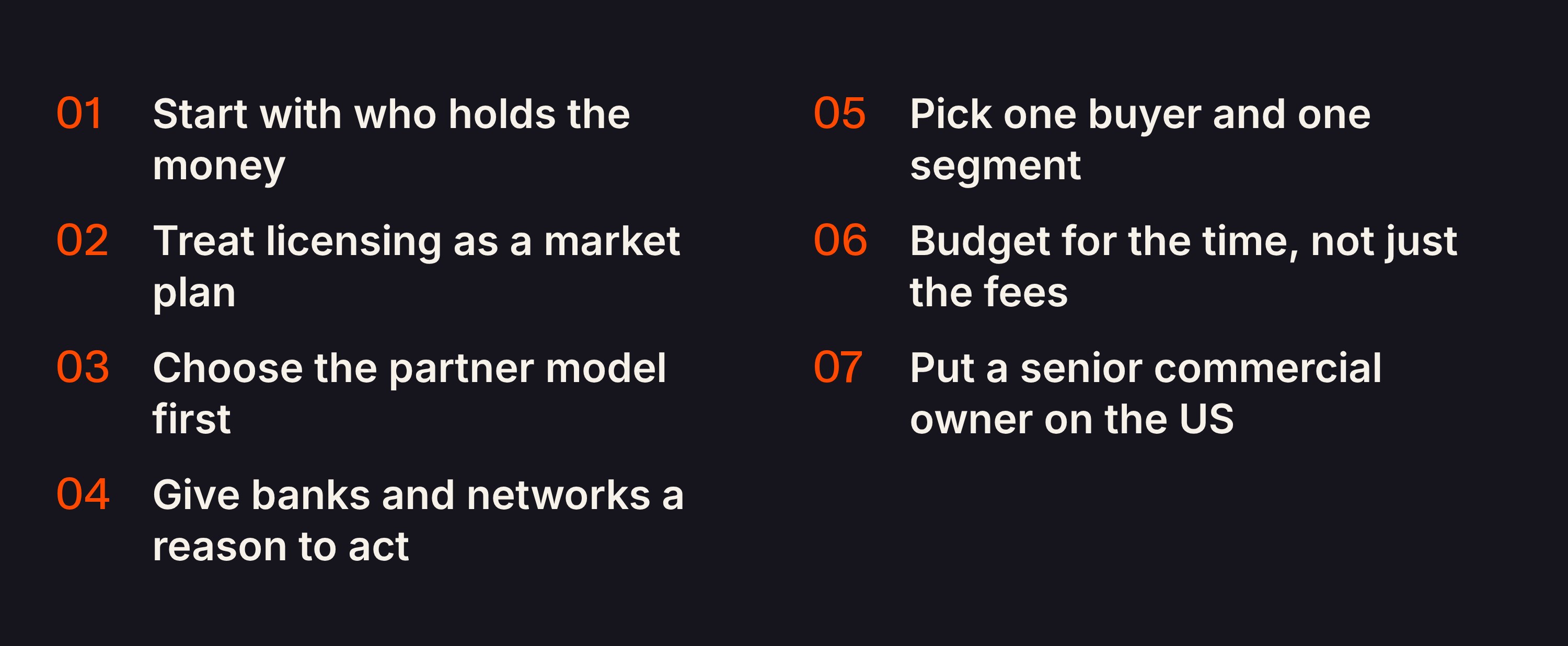
1. Start with who holds the money
Before pricing, before hiring, before a US entity, draw the flow of funds. Who pays, who receives, and whose account does the money sit in on the way? This one drawing decides most of what follows.
If your product moves or holds customer funds, you are probably in money transmission territory, and that means licenses. If a licensed bank or payment partner holds the funds and you provide software, data or orchestration on top, the regulatory load can be much lighter, but you depend on that partner. If you sell to banks and processors as a technology vendor, you are mostly facing vendor due diligence, not licensing.
Many European fintechs hold an e-money or payment institution license at home and assume it travels. It does not. A European license is useful evidence that you can run a compliance program, and US partners and regulators will want to see it, but it does not let you transmit money in any US state.
2. Treat licensing as a market plan
Money transmission in the US is licensed state by state. On top of that, a money transmitter generally has to register with FinCEN as a money services business, which is a federal registration and separate from the state licenses. Most states take applications through NMLS, the Nationwide Multistate Licensing System, but each state reviews its own application and sets its own requirements for net worth, surety bonds, financial statements and background checks on the people who control the company. The Money Transmission Modernization Act, a model law, has been adopted by a number of states and has made some requirements more consistent, but you still deal with each state separately.
When we led the work on SEQR’s first US licenses, the lesson we took away was that the licensing plan and the commercial plan are the same document. Every state you apply in costs time, bonding and management attention. Every state you do not apply in is a state where you cannot serve customers on your own license. So the sequence has to follow your buyers: start with the states where your first customers, partners and corridors are.
Three questions to settle early:
- Which states do we need for the first 12 months of revenue, and which can wait?
- Do we license ourselves, work under a licensed partner for now, or do both in phases?
- Who in the company owns the compliance program, the BSA/AML officer role and the relationship with examiners?
The honest answer for many companies is to launch with a licensed partner and apply for their own licenses in parallel, starting with a short list of states. That keeps revenue and licensing moving at the same time.
3. Choose the partner model before the product roadmap
If you are not holding funds yourself, someone else is. In the US that is usually a sponsor bank, a licensed payment company or a processor. Card issuing needs a bank that sponsors the program on the network. Account products need a bank that holds the deposits. Merchant acquiring runs through acquirers and processors with their own underwriting.
These partners are not interchangeable. They differ in which risk they accept, how fast they onboard, what they charge and how much control they want over your compliance. A partner that fits your first use case may not fit your third. Choose based on the first program you want to launch, and ask each partner directly how they would handle your second one.
We wrote about the commercial side of this in defining the commercial partner before you scale. The short version: name the missing capability, then find the partner whose incentives match it.
4. Give banks and networks a reason to act
At Visa and at Euronet, we sat on the other side of the table. Banks, processors and networks see a steady stream of fintechs asking for partnerships. The ones that get attention bring a defined program, a clear customer segment, a realistic volume story and a compliance setup the partner’s risk team can approve without rebuilding it.
What does not work is a general request to “explore opportunities.” What works is a bounded first program: this customer segment, this product, these states, this expected volume, this timeline, and this is what we need from you. The partner can see exactly what they are saying yes to. We have seen the same from the fintech side, including when we helped Floid land its partnerships with Mastercard and Experian.
If enterprise partnerships are central to your plan, our enterprise sales and partnerships work covers how we structure those conversations.
5. Pick one buyer and one segment
The US is not one payments market. Small merchants, mid-market software platforms, banks and credit unions, and cross-border corridors are different businesses with different sales cycles, buyers and economics. A European fintech that tries to sell to all of them at once ends up with a long partner list and no reference customers.
Pick the segment where your product is clearly better and where the buyer can say yes without a two-year procurement process. Then make the offer concrete in US terms: US pricing in dollars, US payment rails your buyer actually uses, such as ACH, cards, RTP or FedNow, and integration with the systems they already run. If you sell to US customers from Europe today, our piece on accepting payments from US customers covers the basics on that side.
6. Budget for the time, not just the fees
Payments entries take longer than founders expect, and the delay is rarely one big blocker. It is partner due diligence, bank onboarding queues, license reviews, compliance hires and contract negotiations running one after another instead of in parallel.
Build the plan around the critical path. Decide what can start now (partner conversations, buyer validation, the compliance program), what waits for a partner decision (product build for the US rails) and what waits for evidence (a US team and office). This is the same principle we describe in building US traction before fixed cost: add structure when a customer, a partner or a regulator requires it.
7. Put a senior commercial owner on the US
Payments partnerships in the US are won by someone who can speak for the company: on risk, on pricing and on commitments. If every question goes back to Europe, partners slow down. Early on, that person is often the CEO or a founder, supported by someone who knows the US payments ecosystem. Our comparison of a fractional CCO and a US VP of Sales covers when each makes sense.
A checklist before you commit
- Have we drawn the flow of funds and had counsel confirm what it means for licensing?
- Which states do we need in year one, and in what order?
- Which partner model do we launch with: our own licenses, a licensed partner, a sponsor bank, or a mix?
- What is our first program, in one paragraph a bank risk team could approve?
- Which US segment and buyer do we start with, and what is the price in dollars?
- Who owns compliance, and who owns the US commercial relationships?
- What result by when makes us continue, adjust or stop?
Frequently asked questions
Does a European payment license let us operate in the US?
No. It is useful evidence of your compliance program, but money transmission in the US needs state licenses or a licensed partner, plus FinCEN registration where it applies. Confirm your specific case with US counsel.
Do we need a license in every state on day one?
Usually not. Many fintechs start with a licensed partner or a short list of states that matches their first customers, and add states as the business grows.
Should we partner or get our own licenses?
Often both, in phases. A partner gets you to revenue sooner; your own licenses give you control and better economics later. The right mix depends on your flow of funds and your first segment.
How long does it take to break into US payments?
Longer than a software launch. Partner onboarding and licensing run on their own timelines, which is why the plan should start partner and buyer conversations at the same time as licensing.
Where Greatweek fits
Greatweek helps European and Nordic fintech CEOs make the US decision on evidence and carry it into the market. Our US market entry work defines the segment, offer, pricing, partner model and sequencing, and the US Market Entry Playbook shows the full approach. In payments, that includes mapping the licensing path with your counsel and opening the bank, processor and network conversations.
If you are taking a payments or fintech company to the US, book a call with us and we can look at your flow of funds, your partner options and what to do first.